I work as Equality, Diversity and Inclusion (EDI) Manager and soon to move from the University of East London to a different institution. As people who know me will be aware, I can get very engrossed in work and the last couple of months, the notice period, has been a welcome opportunity to step back, reflect and handover.
Working within EDI can be both rewarding and at times frustrating. The process of culture change can be very slow and full of challenges but when you do have those breakthrough moments, however small, this can be extremely rewarding. Given the extent of inequities within HE, I am perhaps naively surprised when asked whether a focus on EDI broadly or on specific issues is still needed. For example, I have been asked recently whether we really need a women’s network as “we have equality now don’t we?” or “racism in our institution? not here, not at UEL?”.
Over the past approximately 5 years, I am proud to have had the opportunity to collaborate with colleagues across the institution. Perhaps, a couple of the most apparent EDI related results of this collaboration being achievement of the Athena SWAN institutional bronze award in 2017, aimed at progressing gender equality, and our institutional Race Equality charter (REC) bronze award received in May 2019 which highlighted racism as well as both existing and new anti-racist strategies within the institution. Both of these processes, through facilitating organisational ‘self-reflection’ and consultation, certainly highlighted the urgent importance of EDI work. Yet while they provide a strategic approach to highlighting and tackling inequities with potential to improve engagement and facilitate cultural change, they are problematic for a number of reasons.
One of the common misconceptions in relation to the Charter Marks is that receipt of an ‘award’ means gender and race equality issues have been solved. A better term for the bronze level ‘award’ would perhaps be ‘commitment’ or ‘pledge’ as a result of ‘coming clean’; as a colleague recently put it ‘hello my name is the department of xxx and I have a problem with gender equality and I am committing to do something about it’.
Charter Marks required focus on data goes some way to uncovering inequities within an institution, such as the degree awarding gap within our REC submission. 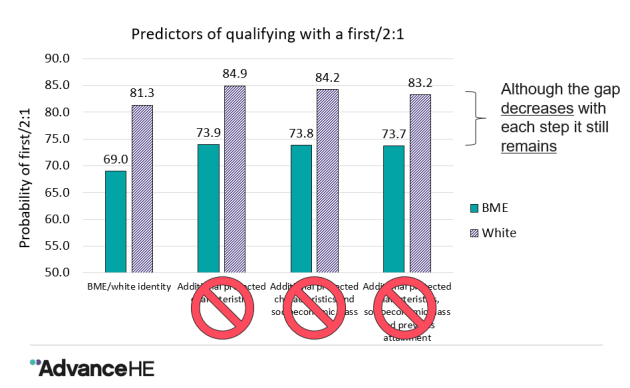 .
.
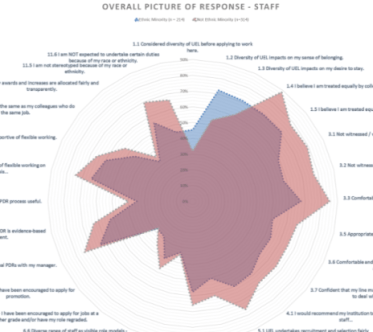
Consultation also highlights inequities. For example, our REC survey highlighted lived experiences and the fairly consistent worse experiences of BME staff compared to non BME staff.
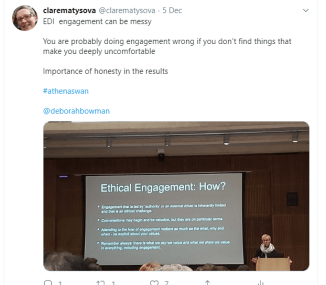
However, in the context of education marketisation and concerns regarding reputational risk, this key issue of engagement is problematic. This was so well described in a presentation on ethical engagement at a recent Athena SWAN event. Meaningful EDI engagement can be really messy leading to discussions about how the findings of such engagement should be shared, to whom and who is / should be responsible for facilitating the necessary changes.
Further, the separate charter marks focus on specific protected characteristics which can lead to creating a hierarchy of different issues rather than the intersectional approach which is needed.
Of course, it is for some of these reasons that the current review of Athena SWAN charter mark is taking place in order to understand its effectiveness for creating sustainable change. But it is not yet clear to what extent the review will focus on the effectiveness of the ‘self-assessment’ process in tackling the above issues and actually provoking the needed critical discussions of gender or race, or indeed intersections with other protected characteristics.
A key objective relating to Athena SWAN is developing a more consistently inclusive working environment which recognises the value of flexible working to both individuals and the organisation which is key to tackling the gender pay gap in HEIs. Focusing on this area, what would a more meaningful discussion of gender mean in relation to working conditions and caring responsibilities? How does this intersect with other protected characteristics? Could a more critical discussion of gender deconstruct assumptions, for example, about who cares and expose some of the more hidden experiences?
While the Athena SWAN submission requires institutions or departments to reflect on facilitating flexible working; it perhaps does not effectively dismantle ongoing norms or the framing of work as ‘full time’.
Reflecting on my own experience, luckily my most recent line managers have been supportive but it hasn’t always been that way. I have, following returning from maternity leave 16 (and 7 and 3 ish) years ago, worked various working patterns from 0.5 to 0.9 FTE. I am really conscious of the impact that the limited opportunities to work outside of the 9-5 norm has had on my career progression. Firstly, given the limited number of roles that tend to be advertised outside of this continuing norm especially at more senior levels. Secondly, when you know assumptions are made about your experience, ability or work ethos because you do not work the 9-5 norm. I have had to constantly push for working more flexibly and act as a role model to show that it can work as well as demonstrating that I have an interest in developing my career.
I have witnessed numerous conversations about academic workload and working hours, where the narrative is led by a need to work extensive hours in order to be a successful academic. 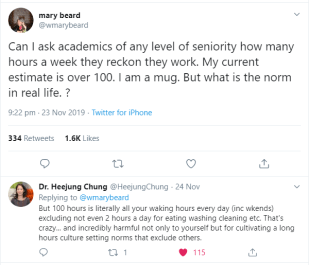 Other conversations have reflected on men ‘taking advantage’ of Athena SWAN through increased promotion of paternity leave or shared parental leave (SPL). Yet given the potential for SPL to reduce the impact of maternity leave on women’s career continuity and progression, as well as create greater opportunities for fathers to engage with their children (Javornik and Kurowska, 2019), these are the kinds of assumptions which we should be challenging.
From an intersectional perspective, our REC self-assessment highlighted different experiences in relation to flexible working and perceived ability to take advantage of flexible working informally. The findings suggested race-specific issues, in addition to gender, namely that BME staff are being treated differently to their white counterparts and experiencing differing levels of line manager trust in relation to working pattern.
Further, there are many hidden experiences in relation to maternity leave, return from maternity, miscarriages, menopause that are often not shared because of fear of repercussions or perhaps because of the risks associated with being on a precarious contract or a pending re-structure. Not restricted to my current place of employment, I know of women who have returned to work worried about or knowing they are miscarrying for these reasons, not allowing themselves any time to grieve.
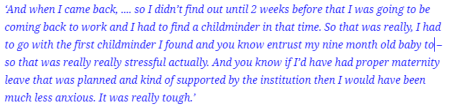
Other examples include female academics on precarious contracts who have reported the extent of anxiety caused by uncertainty while on maternity leave; more than one woman describing their experience as having compromised their identity to the extent of putting them off having further children – as this quote from my MRes dissertation reflects.
As research on the role of policy and culture in relation to carers in HE suggests, especially for academic roles, a reliance on individualised approaches rather than policy, often renders care work invisible (Moreau and Robertson, 2019). These issues are set within broader gendered social norms which still sees women as the main carers. This has implications in the workplace, for example, in terms of continuing job segregation and limiting career progression opportunities for (disproportionately female) ‘part time’ employees, such as those described above and which Athena SWAN could perhaps more effectively challenge.
Clearly these examples are focus on caring responsibilities; similar analysis of other equality issues would highlight an equally complex picture.
So reflecting back on UEL’s Charter Mark awards, have these really lead to meaningful change? It is much too early to say. For issues that have been highlighted, a clear commitment has been made. Other issues remain under-explored. There are some small but significant examples of change such as the proposed removal of the stipulation for 26-week employment prior to being eligible to request flexible working and more positive framing of the flexible working policy. Other examples of key progress to date, linked to the REC, being the launch of the new cross-institutional Equity Collective, an inclusive and anti-racist pedagogies community of practice; a commitment to facilitating development workshops aimed at tackling the good honours awarding gap and the development of ‘Stories of Success‘, led by our student intern, Jacqueline Owusu.
So is EDI work needed? Definitely, and after the latest election result even more so!
In terms of the role of an EDI practitioner (or team), the existence of a team implies an organisation’s recognition of the need to do EDI work, certainly a response to requirements around compliance with equality legislation; hopefully it reflects a more meaningful recognition of a need for culture change and activism. Sara Ahmed in ‘Living the feminist life’ highlights the contradictions of the role of EDI practitioners or teams excellently and suggests that they can have ‘an oblique relation to the institution’ (Ahmed 2017: 94). There is the potential for organisational over-reliance on a centralised EDI team to somehow absolve an organisation of embedding EDI throughout and institutional commitment to EDI does not necessarily equate to an understanding of what this might in practice require or an organisation’s readiness for change. Hopefully, however, as appears to be the case, there has been that ‘coming clean’ to some extent and a commitment to act. I hope that going forward a more nuanced deconstruction of gender, race, or other protected characteristics and an intersectional approach can tackle some of the more hidden issues mentioned above.
Finally, at UEL specifically, my experience has been that there are amazingly dedicated colleagues across the institution who champion equity and inclusion on a daily basis – you know who you are, I hope your work is recognised more widely, it has been a privilege to work with you!
“If it’s a good idea, go ahead and do it. It is much easier to apologise than it is to get permission” (Rear Admiral Grace Murray Hopper)


Leave a comment